
Frequently asked questions about synthetic golf greens
Updated on 5 October 2026
Quick Golf Company designs and installs custom synthetic turf golf greens for private clients and clubs, in Belgium and abroad. Founded by Quentin de Valensart, a former professional player, the company builds putting greens, pitching greens and golf simulators with products made in Belgium. Below you will find answers to the questions our clients ask most often: price, size, installation, maintenance and warranties.
Can’t find your answer? Contact us: the quote is free.
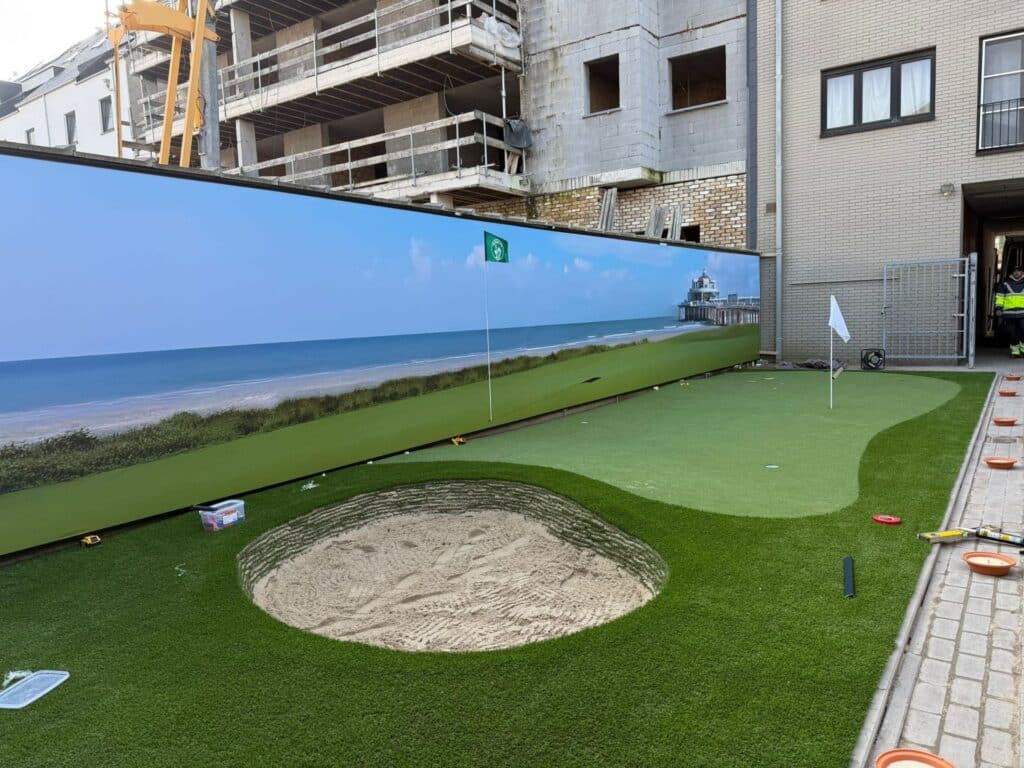
The synthetic golf green
What is a synthetic golf green?
A synthetic golf green is a playing surface made of artificial turf, designed specifically for putting or approach shots and installed on a compacted, drained foundation. Unlike decorative turf, its short fibre gives a consistent and accurate ball roll. At Quick Golf, every green is custom designed: shapes, slopes, number of holes and fringe (a border of longer turf) are adapted to your garden.
Why install a synthetic green rather than a natural one?
A synthetic green lets you play at home with no mowing, no fertilising and no watering to promote growth, whereas a natural green requires very close mowing and constant agronomic care. It suits golfers who want to practise often, in short sessions, with maintenance limited to cleaning and brushing. It can also replace a lawn that grows poorly because of shade or the garden’s orientation.
Does a synthetic green feel the same as a real green?
Yes, a quality synthetic green offers a roll very close to that of a good natural green: our putting greens run at about Stimp 10, which means a ball roll of about 3 metres on the Stimpmeter. How the ball reacts to approach shots depends on the system chosen, which is why the pitching green uses a specific fibre and underlay. The best approach is to test the surface with your own putter before deciding.
Do Quick Golf products withstand rain, frost and heat?
Yes, our turf withstands high temperatures, long periods of rain and cold. Most of it is made of polyethylene (PE) fibres and is guaranteed for 10 years against UV discolouration. Like any artificial surface, the green can get hot in full sun, so the location is chosen with exposure in mind.
Where are Quick Golf products made?
All the synthetic turf installed by Quick Golf is designed and made in Belgium. These are high-end products, laid by our own teams.
Putting green or pitching green
What is the difference between a putting green and a pitching green?
A putting green is used to practise putting and chip-and-run shots, while a pitching green also receives lofted balls (approaches, lobs, bunker shots). The pitching green uses a fibre that can hold 28 kg of sand per m² and a shock-absorbing underlay, which together absorb the impact of the ball. It is the surface closest to a real playing situation on a course.
| Putting green | Pitching green | |
|---|---|---|
| Shots practised | Putting, chip-and-run | Putting, short and long approaches, lobs, bunker shots |
| Surface | Short two-tone fibre | Sand-filled fibre (28 kg of sand/m²) + shock-absorbing underlay |
| Ball roll | ± 3 m (± Stimp 10) | Nearly 3 m |
| Space | Ideal for small areas, close to the house | Requires hitting areas and clearances |
| Indicative price | €150 to €175 excl. VAT/m² | ± €200 excl. VAT/m² |
Which green should I choose for my garden?
Choose a putting green if your space is limited or close to the house, and a pitching green if you have room to play lofted approaches safely. The right question to ask is: do you mainly want to roll the ball, or also land it on the green? Quick Golf advises you during the first visit based on your site and how you play. See: Putting green · Pitching green
Can a bunker or tee area be added?
Yes, a Quick Golf green can be complemented by a practice bunker, hitting mats, an approach area or a tee area. These options are planned from the design stage to keep ball flights and walkways safe. For a full hole, we also build target greens with a softened bounce.
How many holes should a putting green have?
Allow on average one hole per 10 m² of green. Holes, cups and flags are positioned to vary distances, slopes and drills.
Price and quote
How much does a synthetic golf green cost?
A synthetic putting green costs about €150 to €175 excl. VAT per m², and a pitching green about €200 excl. VAT per m². The smallest projects are generally invoiced at around €5,000 excl. VAT. The final price depends on the size, site access, the groundwork required and the options chosen.
What affects the price of a green?
Five factors influence the budget: the size and type of green, access to the garden (a narrow passage makes delivering materials harder), earthworks and any retaining structures, drainage, and options (number of holes, contours, bunker, hitting areas). Two greens of the same size can therefore require very different work. When comparing two quotes, check that they include the groundwork, foundation, drainage and finishing, not just the turf.
Is the quote free?
Yes, Quick Golf quotes are 100% free. For a quick estimate, send us the location of the site, its approximate dimensions, a few photos, the access and the type of play you want (putting, approaches or both). Request a quote
Size, site and installation
How much space is needed to install a green in a garden?
There is no minimum size: Quick Golf adapts each green to the available space, from small city gardens to large estates. The usable shape, the access and the playing distances matter as much as the square metres. A pitching green also needs room for hitting areas and ball flight.
Can a green be installed on a slope, a roof or a narrow space?
Yes, we correct levels during the groundwork and, if needed, build retaining structures to maximise the flat areas. Our greens are already installed on city-centre rooftops, sloping gardens, narrow spaces, forest areas, former horse tracks and even on the Place du Casino in Monte Carlo. The green can also cover inspection chambers and fit around existing features.
How long does it take to install a synthetic green?
A project of less than 50 m² generally takes 3 days on site. Larger projects or those requiring major earthworks take longer; the schedule is set with you once the plans are approved.
How does a project with Quick Golf work?
A project has three phases: preparation, structural work, then laying the green.
Preparation: meeting and measurements, free quote, second visit if the quote is accepted, layout drawn on the ground, plans (contour lines, design, slopes approved with you) and scheduling.
Structural work: cutting out the existing grass, groundwork and shaping with a mini-excavator, installing buried edging and sleeves for the holes, geotextile, then a stable base of gravel or stabilised aggregate.
Installation: setting the cups, shock-absorbing underlay (shockpad), laying and joining the green and fringe, edge finishing, and sand filling if the green is sand-filled.
Our teams have 10 years of experience in installing synthetic golf greens.
How is rainwater drained away?
Water passes through the permeable turf and then through the free-draining gravel or stabilised aggregate foundation, laid on a geotextile. The drainage solution is adapted to your garden’s soil and levels from the design stage, to avoid puddles and preserve the contours.
Does the green have edging?
Yes, every green has edging, buried if the green is surrounded by lawn, or above ground if it borders flower beds. The fringe, a longer synthetic turf, provides the visual transition to the garden and lets you practise short approaches.
Maintenance and durability
How do you maintain a synthetic golf green?
Maintaining a synthetic green comes down to blowing away leaves and debris, brushing the surface regularly and cleaning off occasional dirt. There is no mowing, watering or fertilising. Good habits:
Blow the green clean each time the neighbouring lawn is mown, and about every 3 days when leaves are falling or in spring.
Trim the edge of the fringe with a strimmer or with a mower set to its maximum height.
Rake the bunker towards the centre when the lawns are mown.
Clean off bird droppings with a water jet, with a little washing-up liquid if necessary.
Avoid walking on the green in muddy shoes and never drive machinery over it.
Can weeds and moss grow on the green?
Yes, seeds or moss can take hold in organic deposits (leaves, soil) left on the surface. In the event of an infestation, a moss or weed treatment can be applied. Regular blowing remains the best prevention.
What is the warranty and lifespan of a Quick Golf green?
Our synthetic golf turf is guaranteed for 10 years against UV discolouration. The actual lifespan depends on the product, the quality of the installation, how often it is played on and the maintenance. A change in the roll or a deformed area warrants an inspection by our teams.
Does Quick Golf provide follow-up after installation?
Yes, we give you the maintenance instructions specific to your surface and remain available to advise or step in. Ask us for advice before using a new machine or a new cleaning product on the green.
Quick Golf and its services
Who is Quick Golf?
Quick Golf Company is a Belgian company that designs and installs synthetic golf greens, based in Overijse and founded by Quentin de Valensart, a former professional player. It works for private clients and clubs alike, including the Royal Golf Club des Fagnes and the Royal Golf Club de Belgique, and built the temporary green installed on the Place du Casino in Monte Carlo. See our projects
Which regions does Quick Golf cover?
Quick Golf works throughout Belgium (Brussels, Wallonia and Flanders) and also travels abroad, notably to Luxembourg and France. International projects are assessed on a case-by-case basis.
Does Quick Golf install indoor greens?
Yes, we build indoor putting greens and custom golf simulators, in a cellar, garage, office or dedicated space. See: Golf Designer
Does Quick Golf work for golf clubs?
Yes, our Greenkeeping service helps clubs create synthetic turf tees, eco-bunkers, capillary concrete bunkers, hitting strips and driving range targets, as well as practice putting and pitching greens. See: Greenkeeping
Does Quick Golf offer other synthetic surfaces?
Yes, we also supply decorative turf for gardens and terraces. Sports pitches (football, hockey, rugby…) are built by our Quicksports division.